African Heritage & Indigenous Wisdom
There is a persistent habit, inside and outside Africa, of treating the continent's indigenous knowledge as something to be preserved behind glass — folklore for cultural festivals, proverbs for greeting cards, masks for museums. It is admired the way an old photograph is admired: fondly, and from a safe distance, with no expectation that it has anything to say about tomorrow's problems.
That framing gets the story backwards. African indigenous wisdom was never decorative. It was infrastructure — the accumulated, tested knowledge that let societies govern themselves, grow food, resolve conflict, and transmit values for centuries without the state apparatus the modern world now treats as mandatory. Much of it still works. The question is not whether it's worth remembering, but why so much of it was set aside.
Governance Before the Imported Blueprint
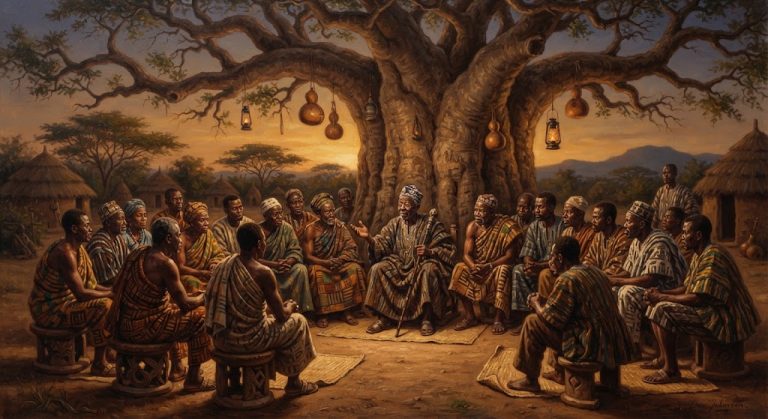
Long before colonial borders imposed the nation-state as the only legitimate unit of authority, African societies had already built varied, functioning systems of governance suited to their own scale and context. The Yoruba operated sophisticated city-states with checks on the Oba's authority through councils like the Oyo Mesi. The Igbo, further east, built a largely decentralized republican order run through councils of elders, kinship groups, and age-grade societies rather than a throne. The Ashanti united historically rival groups under a confederacy anchored by shared ritual symbols and negotiated authority. These were not primitive stopgaps awaiting the arrival of "real" government — they were tailored answers to the problem every polity faces: how to make collective decisions and constrain power. Many were more accountable, in practice, than the centralized administrative structures colonial powers substituted in their place.
Knowledge That Was Never Written Down — By Design
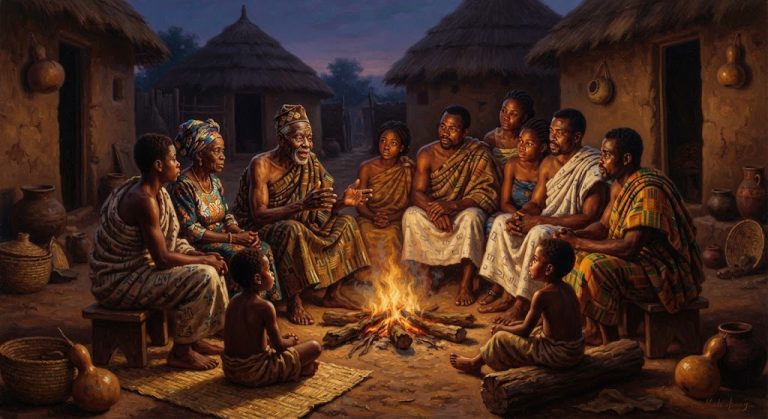
Africa's indigenous knowledge systems were mostly oral, and that fact is often misread as a weakness rather than a design choice. Oral transmission through griots, elders, proverbs, and initiation systems kept knowledge embedded in relationship and context rather than abstracted onto a page. A griot in the Mali Empire wasn't a passive storyteller; he was a living archive of genealogy, law, and history, whose knowledge was cross-checked and renewed constantly through public performance. Proverbs did similar work at a smaller scale, compressing ethical and practical guidance into portable form — the Akan proverb warning that the ram butts hardest just before it is slaughtered, or the widespread African maxim that it takes a village to raise a child, both carry generations of observed behavior in a single line. These systems were resilient precisely because they lived in people rather than in vulnerable, single-point archives.
Ecological and Medical Knowledge Earned the Hard Way
Long before laboratory science mapped biochemistry, indigenous communities across the continent had already identified which plants healed, which soils held water, and which farming rhythms kept land fertile across generations. Traditional healers across West and Central Africa built extensive pharmacopeias through generational trial, observation, and refinement — knowledge Western pharmaceutical research has since spent considerable money "rediscovering" through bioprospecting. Land and water management systems — rotational grazing among Fulani pastoralists, intercropping practices in the Sahel, sacred groves that functioned as de facto biodiversity reserves — reflect ecological understanding built from direct, sustained dependence on the land, not abstract theory. Colonial and postcolonial development schemes that ignored this knowledge in favor of imported agricultural models frequently failed for exactly that reason.
Conflict Resolution Without the Distant Court
Many indigenous African systems handled disputes through restorative rather than purely punitive logic — restoring relationships and community balance rather than simply assigning punishment. Gacaca-style community courts in the Great Lakes region, Igbo Umunna mediation, and various elder-led reconciliation processes across the continent all share this same underlying premise: that a dispute settled by distant, anonymous authority resolves the case but not necessarily the relationship, while a dispute settled by known elders, in view of the community, tends to actually hold. Rwanda's post-genocide reliance on adapted gacaca courts, alongside formal tribunals, is one of the clearest recent examples of an indigenous method being consciously revived because the imported model alone could not carry the weight of reconciliation at that scale.
Why So Much of It Was Set Aside
None of this knowledge disappeared because it stopped working. It was actively displaced — by colonial administrations that needed African societies legible and controllable rather than genuinely understood, by missionary systems that treated indigenous belief as something to be replaced rather than engaged, and later by postcolonial elites who often equated modernization with the wholesale replacement of anything "traditional." The cost of that displacement shows up constantly in modern African governance: institutions imported wholesale, with none of the accountability structures that made the older systems work, then wondered at why they don't hold.
Heritage as a Resource, Not a Museum Piece
The case for indigenous wisdom is not an argument against modern science, technology, or the nation-state — those are not going anywhere, nor should they. It's a narrower and more useful point: indigenous systems represent centuries of tested, context-specific problem-solving that shouldn't be discarded simply because it predates the colonial encounter. A continent trying to build governance, justice, and development models that actually fit its own societies has an enormous, underused resource sitting in its own history — proverbs, councils, land practices, and reconciliation methods that were never actually replaced by something better, only replaced by something foreign.
Heritage, understood this way, isn't about looking backward. It's about refusing to keep reinventing, badly, what was already built well.