Indigenous Wisdom among the Igbo: A Living Philosophical Heritage
Indigenous wisdom is the accumulated knowledge, values, beliefs, practices, and ways of understanding life that a people develop over generations through close interaction with their environment, community, history, and spiritual worldview. It is not simply “old knowledge.” It is a living intellectual heritage through which people interpret human relationships, nature, morality, leadership, health, conflict, work, and the meaning of existence.
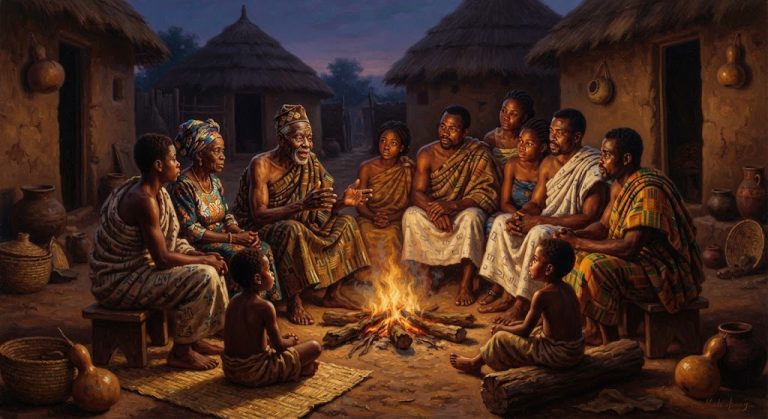
Among the Igbo, indigenous wisdom has traditionally been preserved through proverbs, folktales, songs, rituals, customs, titles, family traditions, festivals, and the teachings of elders. These forms of knowledge served not only to entertain or preserve history but also to educate individuals, regulate conduct, resolve disputes, strengthen social relationships, and explain humanity’s place in the world.
Indigenous Wisdom among the Igbo
Igbo wisdom is often expressed with remarkable clarity through proverbs. A short proverb may contain an entire philosophy about community, responsibility, character, or social life.
The expression “Onye aghana nwanne ya”, meaning “Let no one abandon his brother,” reflects the importance of solidarity and communal responsibility. Traditionally, an individual’s wellbeing was understood to be connected to the wellbeing of the wider community. The proverb does not necessarily refer only to biological brothers and sisters; it can express the broader obligation to support relatives, neighbours, friends, and members of one’s community.
Similarly, “Igwe bu ike,” meaning “Unity is strength,” emphasizes the importance of collective action. Igbo society has often been associated with individual initiative, enterprise, and independence. Yet individual ability becomes more effective when joined with the strength of others. The proverb therefore teaches that cooperation is essential for overcoming difficulties and achieving common goals.
Another important saying is “Okenye anaghị anọ n'ụlọ ewu amụọ,” literally, “An elder does not remain at home while a goat gives birth outside.” Beyond its literal meaning, the proverb teaches that experience creates responsibility. A person who possesses knowledge, authority, or maturity should not remain passive when guidance or intervention is needed. Wisdom is therefore not merely something to possess; it is something to use for the benefit of others.
Elders and Communal Knowledge
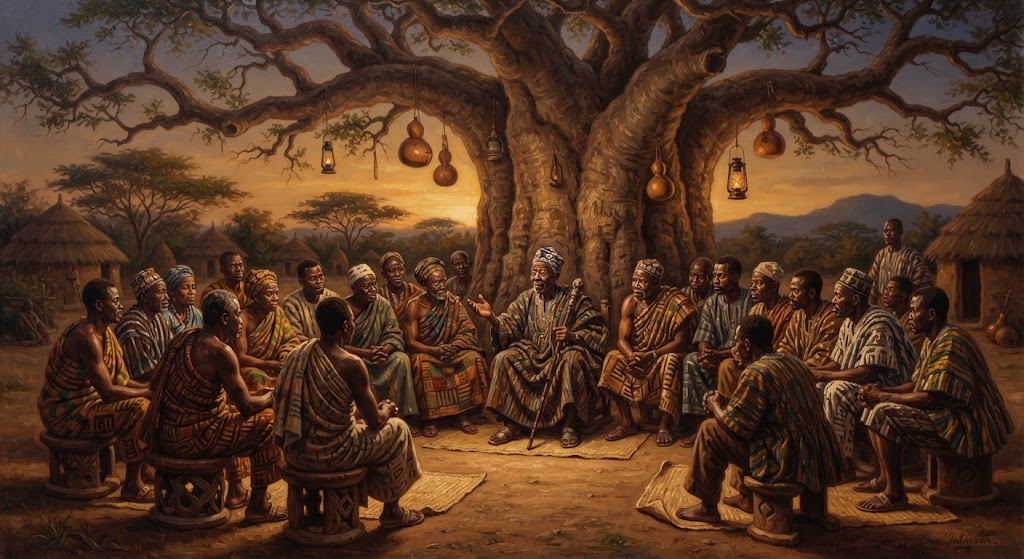
In traditional Igbo communities, elders were regarded as custodians of history, customary law, family memory, and communal values. Their authority was connected not simply to age but also to experience, moral standing, knowledge of tradition, and service to the community.
However, Igbo political life was not based only on the authority of elders. Many communities operated through a network of institutions that included families, village assemblies, age grades, titled individuals, religious authorities, and other community groups. Important matters could be discussed publicly, with different people presenting their positions before the community sought agreement.
This system demonstrates that political authority in traditional Africa was often distributed rather than concentrated in a single ruler. Many Igbo communities were decentralized, or “acephalous,” meaning that they did not necessarily have a central king exercising absolute authority over the entire society.
This does not mean that traditional Igbo governance was identical to modern electoral democracy. Participation could be shaped by gender, age, status, lineage, and title. Nevertheless, these institutions provided forms of consultation, accountability, deliberation, and consensus-building.
The broader lesson is that collective decision-making and political consultation were not introduced into Africa only through European political thought. African societies developed their own systems for sharing authority, resolving disputes, regulating leaders, and protecting communal interests.
Proverbs as Philosophy
Proverbs were among the most important repositories of Igbo indigenous wisdom. They were used in ordinary conversation, family instruction, dispute settlement, public debate, ceremonies, and political discussion. Their authority came from their ability to connect everyday experiences with deeper moral and social principles.
The proverb “Aka nri kwoo aka ekpe, aka ekpe akwoo aka nri,” meaning “The right hand washes the left hand, and the left hand washes the right hand,” teaches reciprocity. Neither hand can clean itself effectively; each depends on the other. The proverb therefore communicates the idea that human beings need one another and that mutual assistance strengthens society.
Another expression, “Nwata kwocha aka, ọ soro okenye rie nri,” meaning “When a child washes his hands properly, he can eat with elders,” teaches personal development, preparation, good conduct, and earned participation. The child’s position changes not through age alone but through responsible behaviour. The saying therefore combines respect for elders with the expectation that younger people can advance through discipline, competence, and good character.
Igbo proverbs often function as moral education in compact form. Scholars describe African and Igbo proverbs as important carriers of ethical instruction, social values, philosophy, and cultural memory. � They teach humility, diligence, courage, wisdom, cooperation, respect, accountability, and awareness of consequences.
African Communal Worldviews
Although Africa contains thousands of peoples and cultures, certain themes recur across many indigenous worldviews. One of these is the understanding that individual identity is formed through relationships with family and community.
The southern African concept of Ubuntu, often summarized as “A person is a person through other people,” expresses a related idea. Ubuntu and Igbo communal thought are not identical, and they belong to different cultural contexts. However, both emphasize that human dignity and wellbeing are connected to social relationships, mutual recognition, and responsibility toward others.
Among the Igbo, this communal orientation can be associated with kinship, the bonds of ị̀dị̀ nwanne, respect for elders, obligations to family, and concern for the welfare of the community. At the same time, Igbo thought has also valued personal achievement, enterprise, courage, and social recognition. The individual and the community were not necessarily opposites: personal success could be admired, but it was expected to carry responsibilities toward relatives and society.
Wisdom about Nature
Indigenous wisdom also includes detailed knowledge of the natural environment. Traditional farmers developed practical understandings of rainfall patterns, soil conditions, indigenous crops, agricultural seasons, animal behaviour, medicinal plants, forest resources, and local water sources.
This knowledge was often transmitted orally through observation, demonstration, family instruction, ritual practice, and participation in farming or healing activities. Indigenous experts could distinguish plants not merely by appearance but by their medicinal, nutritional, agricultural, ecological, or spiritual functions.
Such knowledge should be approached with both respect and critical judgment. Some traditional practices may contain observations that can contribute to modern environmental management, agriculture, and healthcare. Other claims may require scientific investigation or may not be supported by reliable evidence. The appropriate response is neither to dismiss all indigenous knowledge nor to accept every traditional belief without examination.
Modern society can benefit when indigenous knowledge holders work with scientists, educators, health professionals, and policymakers. This type of collaboration can help preserve local knowledge while testing its claims, protecting communities from harmful practices, and adapting valuable insights to contemporary conditions. UNESCO similarly emphasizes collaboration across disciplines so that Indigenous and Local Knowledge Systems can be properly valued and incorporated into sustainable policies and practices.
Leadership and Responsibility
Traditional African political systems often linked authority with responsibility. Leaders were expected to protect the community, uphold custom, settle disputes, and maintain social balance. Their authority could be limited by councils of elders, assemblies, age grades, religious institutions, kinship groups, and established customs.
The Igbo experience is particularly significant because it challenges the assumption that every society requires a centralized monarchy in order to have political order. In many communities, authority was distributed among several social institutions. Decisions emerged through negotiation, discussion, persuasion, and consensus.
This system had strengths, including community participation and restraints on individual power. It also had limitations, including possible exclusion of certain groups and dependence on social hierarchies. A balanced interpretation must recognize both sides. Indigenous institutions should be studied historically and critically rather than idealized as perfect systems.
Indigenous Wisdom Is Not the Same as Superstition
It is important to distinguish indigenous wisdom from superstition. Indigenous wisdom may preserve valuable insights into agriculture, ecology, social organization, morality, conflict resolution, and human behaviour. However, traditional societies also held beliefs that modern scientific investigation may not support.
A responsible approach asks several questions:
What knowledge does this tradition contain?
What problem was it originally trying to solve?
What values does it preserve?
Does evidence support its practical claims?
Can it be adapted to modern conditions?
Could applying it cause harm or violate human rights?
This critical approach protects indigenous knowledge from two opposing errors. The first is cultural dismissal—the assumption that anything traditional is backward. The second is romanticization—the belief that everything ancient is automatically true or beneficial.
Indigenous wisdom deserves respect because it represents accumulated human experience, not because it is beyond criticism.
Why Indigenous Wisdom Matters Today
Indigenous wisdom remains important in a rapidly changing Africa because development should not require the erasure of cultural memory. A society that loses its languages, proverbs, histories, ecological knowledge, and moral traditions may also lose important resources for understanding itself.
The goal, however, should not be a blind return to the past. The more constructive goal is the careful integration of valuable indigenous principles with modern science, technology, constitutional rights, education, and democratic institutions.
Examples include:
Indigenous ecological knowledge combined with modern science can support more sustainable environmental management.
Traditional mediation principles combined with modern law can strengthen community reconciliation.
Indigenous agricultural knowledge combined with agricultural research can encourage locally appropriate and sustainable farming.
Communal values combined with modern social institutions can strengthen social cohesion and public responsibility.
Proverbs and oral traditions incorporated into education can make moral and civic learning more culturally relevant.
This approach treats tradition as a resource for innovation rather than as an obstacle to progress.
The Deeper Meaning
Indigenous wisdom ultimately asks a profound question: What did our ancestors learn about how human beings should live with one another, with nature, and with the unseen dimensions of existence?
For the Igbo, the answers are expressed through community, kinship, ị̀dị̀ nwanne, respect for elders, ancestral memory, justice, reciprocity, personal achievement, courage, and responsibility to the wider society. These principles reveal that Igbo indigenous wisdom is more than folklore. It is a philosophical inheritance that addresses the nature of good character, social order, human interdependence, leadership, and the relationship between people and their environment.
The task of contemporary African intellectuals, educators, and communities is therefore not to reject modernity or to idealize the past. It is to recover, preserve, interpret, test, and adapt the most valuable elements of indigenous knowledge. By doing so, Africa can pursue a future that is scientifically informed and technologically advanced while remaining connected to its own histories, values, languages, and intellectual traditions.
Igbo indigenous wisdom should therefore be understood as a living tradition: one that remembers the past, evaluates the present, and contributes to the construction of a more responsible future.