Why African Stories Are More Than Entertainment
An analytical essay on the cultural, historical, and political function of African storytelling
Introduction
In much of the modern world, storytelling is treated primarily as leisure — a diversion, a form of entertainment consumed and forgotten. But across Africa, storytelling has never occupied that narrow role alone. From the folktales told around a fire in an Igbo compound, to the epic praise poetry of Yoruba oral historians, to the griot traditions of the Sahel, African stories have functioned simultaneously as law, history, moral instruction, spiritual practice, and political commentary. To treat African storytelling as mere entertainment is to miss its true function: a living technology for transmitting knowledge, preserving identity, and holding power accountable across generations.
I. The Custodianship of History
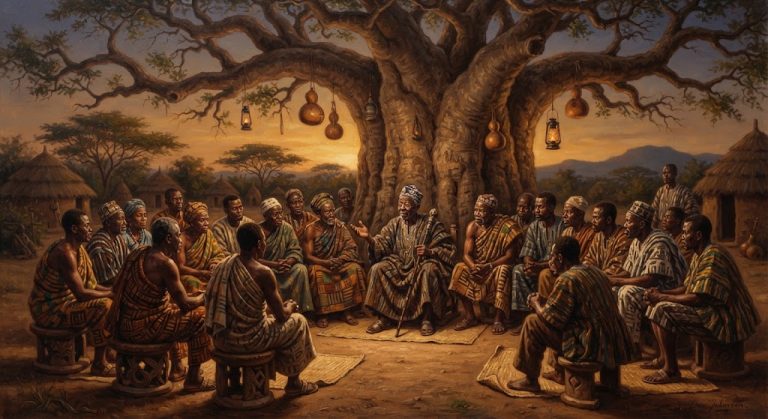
In societies where writing was not the primary medium of record-keeping, oral storytelling was the archive. The griots of West Africa — hereditary oral historians found among the Mandinka, Wolof, and other groups — were not entertainers in the casual sense; they were living repositories of genealogy, royal history, and political precedent. A griot's recitation of a king's lineage could settle disputes over succession or land. Among the Yoruba, oriki (praise poetry) encoded family history, personal achievement, and communal memory into verse that could be recalled and performed for generations. These were not decorative art forms; they were functioning historical institutions, as authoritative in their societies as written archives are in others.
II. Moral and Ethical Instruction
Folktales — the Anansi stories of the Akan, the tortoise tales common across West Africa, the trickster narratives found in numerous traditions — served as vehicles for ethical instruction long before formal schooling existed. A child who heard the tale of the greedy tortoise learned about the consequences of avarice without ever sitting through a lecture on ethics. These stories encoded a community's values around honesty, humility, communal responsibility, and respect for elders, delivering moral education in a form memorable enough to be carried into adulthood and retold to the next generation.
III. Spiritual and Cosmological Function
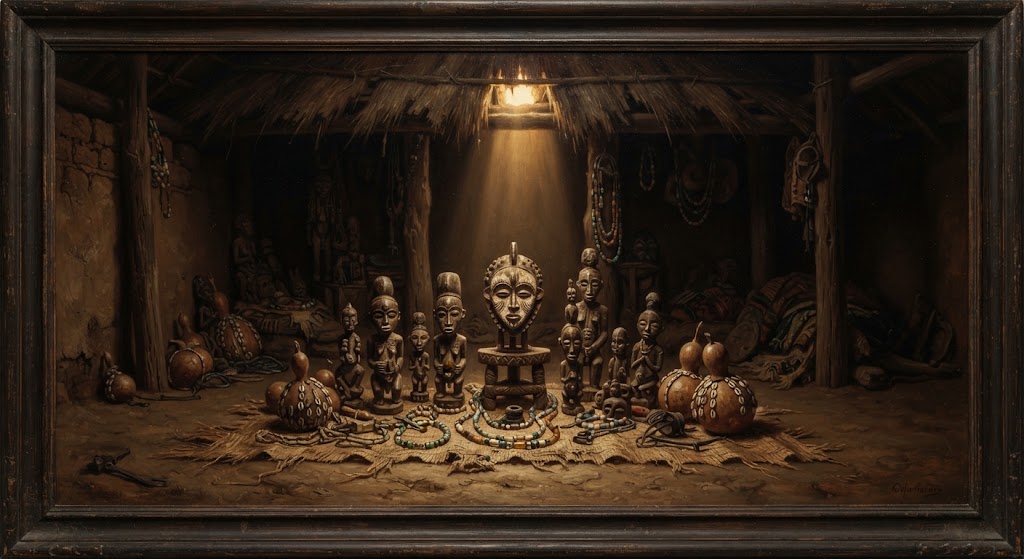
Many African stories are not separable from a society's spiritual worldview. Creation myths, ancestral narratives, and stories explaining natural phenomena served — and in many communities still serve — as a framework for understanding humanity's place in the cosmos, one's relationship to ancestors, and the moral order underlying the visible world. These narratives were not naive attempts at science; they were coherent cosmological systems that gave meaning to existence, mortality, and community obligation.
IV. A Tool of Political Commentary and Resistance
Storytelling in Africa has long carried a subversive political function. Trickster tales, in which a physically weaker character outwits a more powerful one through cunning, allowed communities to symbolically process power imbalances — a theme that took on additional resonance during the colonial period, when direct criticism of colonial authority was dangerous. Praise singers could also wield storytelling as a check on rulers, since a griot's power to praise was equally a power to satirize or withhold praise, creating real social pressure on leadership to govern justly. This tradition of embedding political critique within narrative form persists today in African literature, film, and even contemporary satire.
V. A Closer Look: Storytelling in Igbo and Nigerian Tradition
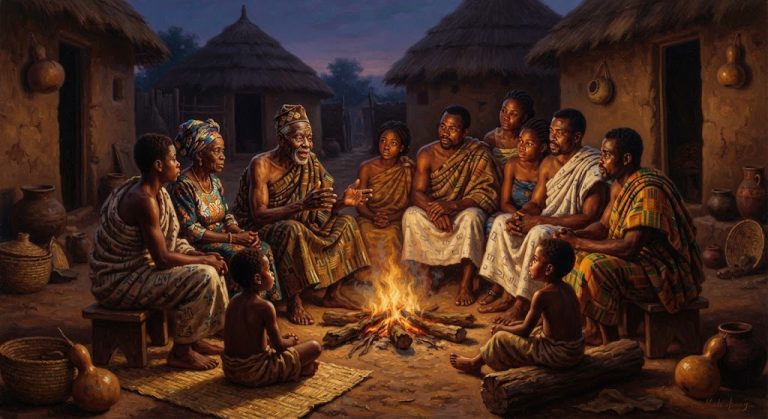
Nigeria offers a particularly rich case study of storytelling's layered function, and the Igbo tradition illustrates this with special clarity. The Igbo folktale (akụkọ ifo) was never simply a bedtime diversion; it was structured pedagogy, typically performed in the evening (uzo abali) after the day's farming and domestic work were done, when children gathered around elders in the compound.
Tortoise (mbe) narratives: The recurring trickster figure of Mbe the tortoise, whose cunning frequently backfires, taught children about the dangers of greed, deceit, and excessive ambition — moral lessons delivered through entertainment rather than direct reprimand.
Proverbs (ilu) embedded in narrative: Igbo storytelling is inseparable from proverbs, which the Igbo consider "the palm oil with which words are eaten." A story was often constructed specifically to illustrate a proverb, compressing complex social wisdom into a memorable form that could later be invoked in adult life — in dispute resolution, negotiation, or counsel — without needing to retell the full story.
Age-grade and title-taking narratives: Stories surrounding the achievements of titled men and women (ozo, among other title systems) reinforced the values a community expected of its most respected members, linking storytelling directly to the reinforcement of Igbo governance and social hierarchy.
Call-and-response performance: Igbo storytelling sessions were rarely passive. The storyteller's use of song refrains, audience response, and dramatized voices for different characters made the story a communal event, not a one-way transmission — a structure that also trained listeners, gradually, in the craft of telling.
This same layered function extends across Nigeria's other major traditions. Yoruba Ifá literary corpus — the vast body of verses associated with Ifá divination — functions as a philosophical and ethical system as much as a religious one, offering guidance on human conduct through narrative and verse. Hausa tatsuniya storytelling traditions similarly combine entertainment with moral instruction, often performed by women and children in domestic settings, encoding lessons about community, caution, and consequence. Across these distinct traditions, a consistent Nigerian pattern emerges: story as the primary vehicle through which values, history, and social order were transmitted long before — and alongside — formal educational institutions.
VI. Identity Formation and Continuity
Stories are how communities tell each other who they are. Origin myths, migration narratives, and stories of communal founding figures give a people a shared sense of identity and continuity across generations. In the context of colonialism's disruption of African self-understanding, storytelling has also functioned as a form of cultural resistance — a means of preserving identity even as external forces sought to impose foreign frameworks of meaning. This is part of why the post-colonial African literary tradition, from Chinua Achebe to Ngũgĩ wa Thiong'o, so often returns to oral narrative forms: not out of nostalgia, but because those forms carry a people's continuity of self.
VII. The Communal and Participatory Nature of African Storytelling
Unlike the largely solitary, consumer-oriented storytelling common in much of the modern entertainment industry, traditional African storytelling is typically communal and participatory. Call-and-response structures, audience interjection, and the expectation that a story will be reshaped slightly with each retelling mean the story is never a fixed, passively consumed product — it is a living communal act, renewed and reinforced through performance. This participatory structure is itself part of the pedagogy: those who listen are also being trained, gradually, to become tellers themselves.
VIII. Contemporary Relevance
This deeper function of storytelling has not disappeared with modernity — it has migrated into new forms. Nollywood films frequently dramatize moral and social lessons in a manner directly descended from the folktale tradition, with the trickster-punished-for-greed arc still visible in countless contemporary plots. Contemporary Nigerian and broader African literature continues to use narrative to process historical trauma, critique governance failures, and articulate identity in a globalized world. Political satire, spoken word, and even social media storytelling on the continent today carry forward the same essential function older oral traditions once served: making sense of power, preserving memory, and shaping collective values.
Conclusion
To call African stories "entertainment" is not wrong, but it is radically incomplete. They are entertainment in the same sense that a nation's constitution is a legal document — technically accurate, but missing the deeper weight of what the form actually carries. From the Igbo akụkọ ifo and its embedded proverbs, to the Yoruba oriki and Ifá corpus, to the griot traditions of the wider West African region, African storytelling has functioned as archive, classroom, spiritual guide, and political check, often all at once. Recognizing this is not simply an academic exercise; it is a necessary corrective to a long history of undervaluing African oral tradition as unserious or purely recreational. The stories our ancestors told, and the stories Africans continue to tell today, are among the continent's most enduring technologies of knowledge — and they deserve to be studied, preserved, and understood on those terms.